NSW Selective High School Placement Test Sample

By Post Author | 26th Aug, 2026
A NSW selective high school placement test sample can reveal far more than whether your child gets questions right. Used well, it shows how they respond when the clock is running, which question types slow them down and whether their current school knowledge transfers to a competitive assessment setting.
For families preparing for selective high school entry, that distinction matters. Strong classroom results are an excellent foundation, but the placement test also asks students to read precisely, reason efficiently, make sound choices under time pressure and produce a purposeful piece of writing. A sample test is the starting point for understanding where preparation should go next.
What a sample test should show you
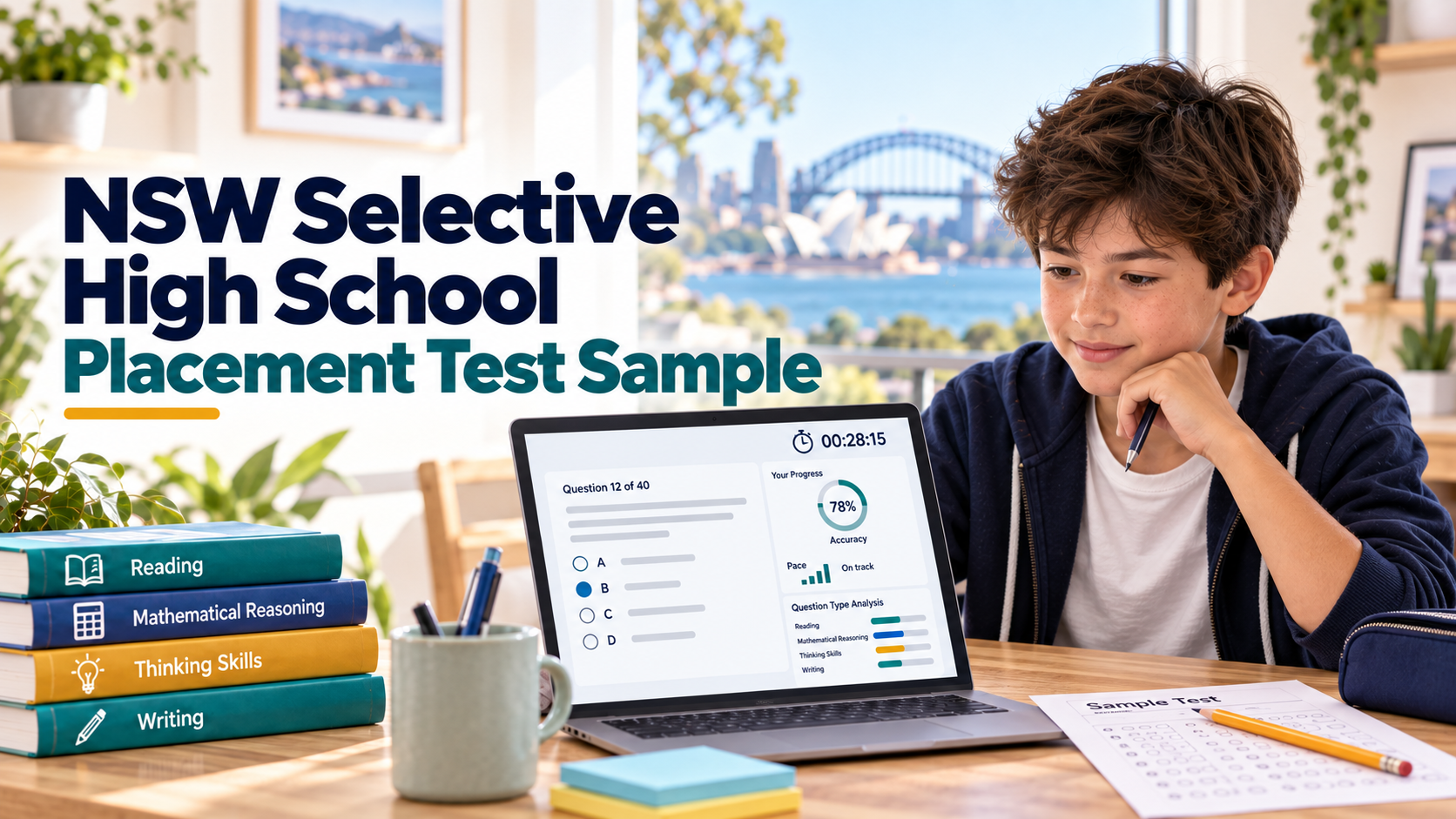
The NSW Selective High School Placement Test assesses four broad areas: reading, mathematical reasoning, thinking skills and writing. A worthwhile sample should reflect the style of challenge in each area, rather than simply offering a collection of difficult school worksheets.
Reading questions require careful interpretation of written material. Mathematical reasoning tests whether students can select and apply the right method, often where the pathway is less obvious than in routine classroom exercises. Thinking skills questions look for patterns, relationships, logic and evidence-based conclusions. Writing requires a student to develop and communicate ideas within a limited time.
A sample is most useful when it gives your child a genuine first encounter with these demands. It should not be treated as a predictor of placement or a one-off score to celebrate or worry about. One result can be affected by unfamiliarity, nerves, a difficult topic or even a rushed start. The value lies in the evidence it produces.
NSW selective high school placement test sample: official versus practice
Families will commonly encounter two types of material: official familiarisation samples and exam-style practice samples. Both have a place, but they serve different purposes.
Official material is the best way to understand the published test structure and the type of instructions students may face. It helps remove avoidable surprises, particularly for children who have not completed a computer-based, timed assessment before. Use it early in preparation, but do not save it for the final week. Your child needs time to act on what it reveals.
Exam-style practice extends that familiarisation. It gives students repeated exposure to comparable question formats, timed sections and new content, so improvement comes from skill development rather than memorising answers. The quality of this material matters. Questions should be appropriately demanding, solutions should explain the reasoning, and practice should match the relevant NSW assessment areas.
A sample that is far easier than the placement test can create false confidence. One that is difficult without being well designed can be equally unhelpful, because it does not identify a teachable gap. Parents should look for material that makes the student think, then clearly explains why an answer is correct.
How to run a useful first attempt
The first sample should be diagnostic. That means creating conditions close enough to the test that the result tells you something reliable, without making the experience feel like a high-stakes judgement.
Choose a quiet space, use the suggested time limit and ask your child to work independently. Avoid pausing to explain a question or offering hints mid-test. If they would not receive that help in the assessment, it will hide the very information you need.
Before beginning, check four practical details:
- whether the sample is meant to be completed in one sitting or by section
- the time available and how your child will keep track of it
- whether a calculator, paper or other tools are permitted for that practice task
- how answers and written work will be reviewed afterwards
For younger students, it can be sensible to start with individual sections before attempting a full mock exam. This reduces fatigue and lets them learn the interface and question style. Once familiarity improves, full timed practice becomes more valuable because stamina, pacing and recovery after a hard question are part of test performance.
Look beyond the percentage score
A percentage is a useful data point, not a preparation plan. The best review happens after the clock stops.
Start with errors. Separate questions your child did not understand from questions they understood but rushed, misread or could not finish. These categories require different responses. A reasoning gap may need guided teaching and several related questions. A careless reading error may call for a slower first read, highlighting key conditions or leaving 30 seconds to check work.
Then look at omissions. In a timed test, unanswered questions often tell a clearer story than incorrect ones. Did your child spend too long on one complex problem? Did they run out of time near the end of every section? Or did they move quickly but make avoidable mistakes? The goal is not simply to work faster. It is to use time more deliberately.
Writing needs a different lens. A strong response should address the prompt, present a clear central idea, use relevant detail and be organised so the reader can follow it. Grammar and spelling matter, but a technically neat response with limited ideas may not demonstrate the same quality as a well-developed piece that needs minor editing. Tutor-reviewed writing is particularly useful here because students need specific feedback on what to develop next, not just a generic model answer.
Turn sample results into a focused plan
Resist the temptation to practise every area equally after one sample. Select the two or three patterns with the greatest impact and build a short, repeatable plan around them.
A child who understands mathematical concepts but loses time might complete short sets under a strict timer, then review the quickest valid method. A student who struggles with reading inference may need to practise identifying what the text suggests rather than searching for a sentence that repeats the question. For thinking skills, the most productive work is often learning to state the relationship or rule before choosing an answer.
For writing, regular short sessions are usually more effective than waiting for an occasional full response. A student can practise planning in a few minutes, generating specific details, improving a weak opening or revising one paragraph for clarity. Full timed writing tasks should still be included, but they work best when supported by feedback and targeted skill practice.
A platform such as Selectivetrial can help families move from a sample result to structured practice through exam-style questions, repeatable timed mocks, detailed solutions, tutor-marked writing and progress reporting. The key is using the data to adjust practice, rather than simply accumulating completed tests.
Avoid the common sample-test mistakes
The first is over-testing. Completing mock after mock without reviewing mistakes can make students familiar with pressure but does little to strengthen the skills underneath. A better rhythm is to use a sample or mock, analyse the result, practise the weak areas, then retest later with fresh questions.
The second is treating every low result as a sign that a child is not suited to selective school. Early scores often reflect a lack of format knowledge or pacing experience. Equally, a high score on a single sample does not remove the need for disciplined preparation. Competitive placement depends on performance across the assessment, and the cohort is academically strong.
The third is comparing siblings, classmates or friends. Students improve at different rates and may have very different profiles. One child may be advanced in mathematics but need support with writing; another may be an exceptional reader who has not yet developed efficient reasoning strategies. The useful comparison is between your child’s current performance and their own previous attempts.
When should families start using samples?
Start early enough to allow change. For some families, this means an untimed familiarisation sample first, followed by a timed diagnostic once the child understands the four areas. For others, especially students already comfortable with competitive testing, an early timed sample may be appropriate.
As the test approaches, samples should become more realistic. Students need to practise beginning calmly, managing each section independently and resetting their attention when a question feels difficult. However, the final days should not be filled with exhausting full mocks. Light review, sleep, routine and confidence in established strategies are often the better choice.
The most useful NSW selective high school placement test sample is not the one that produces the highest first score. It is the one that gives your child a clear next step – and enough time, guidance and quality practice to take it.