How to Study for the High School Placement Test

By Post Author | 27th Aug, 2026
A strong school report is encouraging, but it does not automatically prepare a child for a competitive placement exam. When parents ask how to study for the high school placement test, the most useful answer is not simply ‘do more work’. It is to build the specific knowledge, pace and confidence needed to perform on one timed day.
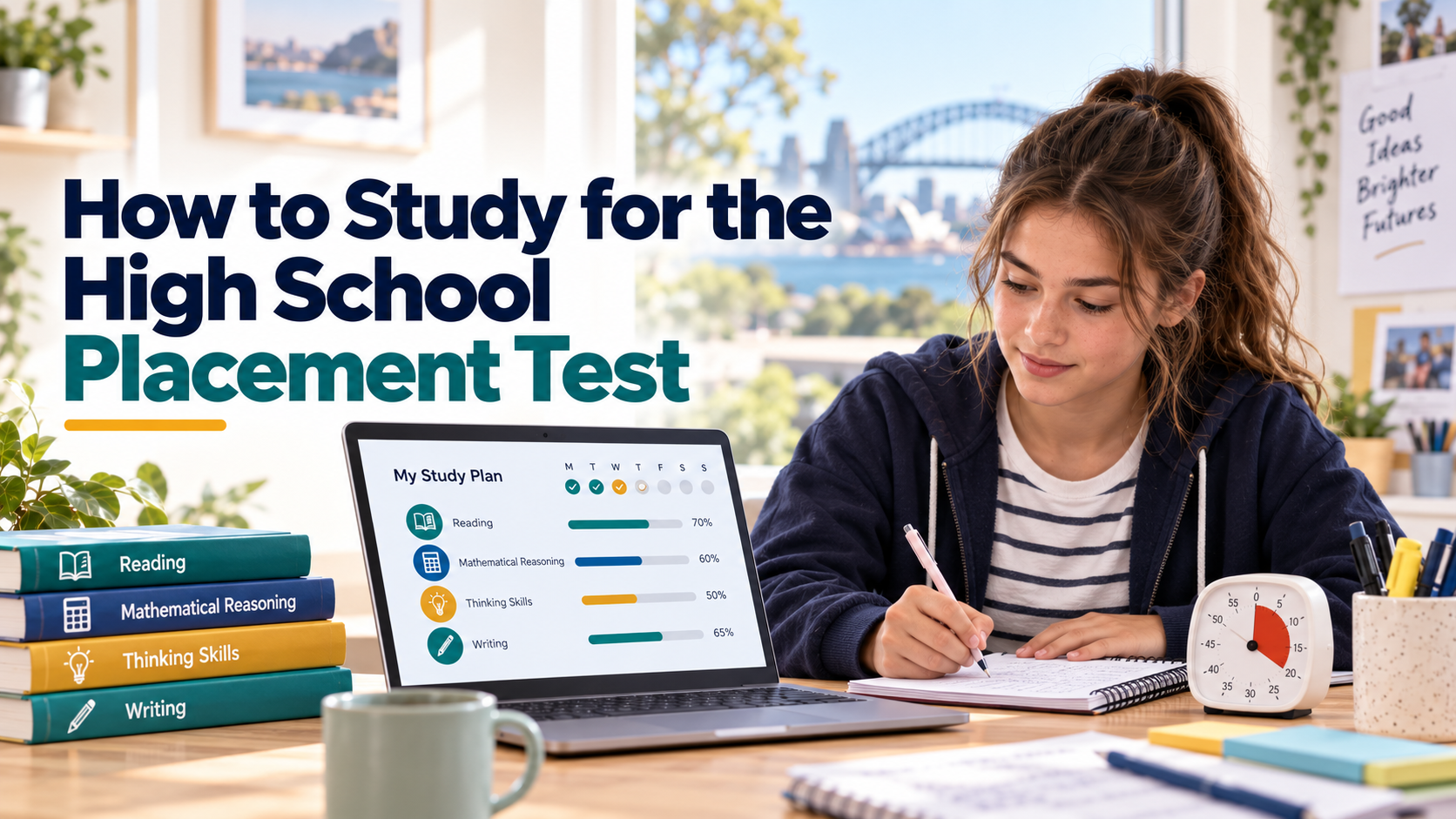
For NSW families, the Selective High School Placement Test assesses reading, mathematical reasoning, thinking skills and writing. Other school-entry and scholarship assessments use different combinations of subjects, question styles and timings. The preparation plan must therefore match the actual assessment your child will sit, rather than relying on generic worksheets or school homework alone.
Start with the test format, not random practice
Before setting a study timetable, confirm the exam authority, year level, test date and subject areas. A student preparing for a NSW selective placement test needs practice with its particular mix of multiple-choice reasoning and writing under time limits. A student sitting a Victorian selective entry or independent-school scholarship assessment may face a different structure and level of emphasis.
This first step prevents a common problem: capable students spending weeks on questions that are too easy, too narrow or unlike the real exam. Ask three practical questions. What skills are tested? How long does each section allow? What does a strong response look like?
Use an initial diagnostic test to establish a starting point. It should be completed independently and, where possible, under realistic timing. The result is not a prediction of placement. It is a map of where to focus. A child may have excellent mathematics at school but lose marks when a multi-step problem must be solved in under a minute. Another may read widely yet need support identifying the precise evidence that answers a comprehension question.
Build a study plan around weaknesses and time available
A plan should be sustainable enough to continue for months, not so intense that it creates fatigue or arguments at home. For many students, three to five focused sessions each week works better than a long daily routine. In the earlier stages, sessions can be 30 to 45 minutes. As the exam approaches, introduce longer timed sections and full mock exams.
Divide study time according to evidence, not preference. Students often choose familiar work because it feels productive. Progress usually comes from deliberately addressing the weakest skill while maintaining strengths. If mathematical reasoning is the lowest area, it may deserve two sessions each week, with reading, thinking skills and writing rotated through the remaining sessions.
A simple weekly rhythm could include targeted skill practice on three days, one writing task with feedback, and a timed mixed-subject session on the weekend. The exact routine depends on the child’s age, school workload and proximity to the exam. During busy school periods, shorter sessions may be the wiser choice. Consistency matters more than an ambitious timetable that is abandoned after two weeks.
Set measurable goals
Replace vague goals such as ‘get better at reasoning’ with targets that can be checked. For example, a student might aim to complete a set of mathematical reasoning questions with 80 per cent accuracy, reduce average time per question, or write a response that uses a clear beginning, developed ideas and an effective ending within the time allowed.
Parents should review results weekly rather than reacting to every individual score. One difficult question set can be useful practice, particularly if it reveals a gap. Look for patterns across several attempts: recurring errors in fractions, slow reading pace, missed keywords in questions, or rushed writing conclusions.
Learn the method behind each subject
High school placement tests reward application, not just memorisation. Students need to understand why an answer is correct and how to reach it efficiently.
In reading, teach your child to read the question carefully before searching the passage for relevant evidence. They should distinguish between an answer stated directly in the text and an inference supported by the text. Encourage them to eliminate options that are partly true but do not answer the exact question. Vocabulary matters, but careful interpretation often makes the larger difference.
Mathematical reasoning requires comfort with number, measurement, fractions, percentages, ratios, patterns and problem-solving. The challenge is often deciding which information matters. After each question, students should explain their steps aloud or in writing. If they cannot explain the method, a correct answer may have been a guess. Worked solutions are valuable because they show efficient approaches, not just final answers.
Thinking skills practice should develop flexible reasoning. Students need exposure to verbal, numerical and abstract patterns, as well as questions requiring logic and deduction. Rather than rushing to an answer, teach them to identify the rule, test it against each option and move on if the question is consuming too much time.
Writing needs its own preparation. A student should practise generating ideas quickly, planning before writing and producing a complete response within the allocated time. Strong grammar helps, but assessors also look for relevance to the prompt, clear organisation, effective vocabulary and control of expression. Tutor-marked writing can be particularly useful here because automated scores and parent impressions cannot always identify why a response lacks development or impact.
Move from practice questions to authentic timed conditions
Untimed practice builds understanding. Timed practice shows whether that understanding holds under pressure. Both are necessary, but they should happen in the right order.
Begin with small, untimed sets when a new topic is difficult. Review every error carefully, including questions answered correctly by guessing. Then introduce section timing. Once your child has developed enough familiarity, schedule full mock exams that reflect real exam timing, subject order and breaks as closely as possible.
Mock exams are more than score checks. They teach pacing, concentration and recovery after a difficult question. Students learn that one challenging item does not mean the whole section is going badly. They also learn when to make an educated choice and continue rather than leaving several later questions unanswered.
Keep the conditions calm and consistent: a clear desk, no mobile, no hints and no interruptions. After the test, take a break before reviewing it. Immediate feedback is useful, but students need enough space to approach mistakes as information rather than a judgement on their ability.
Review mistakes properly
Completing large numbers of questions without analysis can create the appearance of preparation without much improvement. The review is where targeted learning happens.
For each incorrect or slow question, identify the cause. Was there a knowledge gap, a misunderstood instruction, a careless calculation, a timing issue or an unhelpful strategy? Record the pattern in a short error log. Over time, this gives parents and students a far clearer picture than a single overall percentage.
If a student repeatedly misses questions because they rush, the answer may be to practise accuracy at a slightly slower pace before increasing speed. If they understand the content but cannot finish sections, use short timed drills to build pace. If the same topic keeps appearing in the error log, return to teaching and worked examples before doing another mock.
Platforms such as Selectivetrial can help families turn this process into a structured routine, with exam-style questions, repeatable timed mocks, detailed solutions, tutor-reviewed writing and progress data across subject areas. The benefit is not simply more questions. It is being able to see which skills need the next block of study.
Protect confidence without lowering the standard
Competitive tests can make even high-achieving children doubt themselves. Parents can support performance by keeping feedback specific and balanced. Praise effective behaviours – returning to a difficult skill, reviewing errors honestly, completing a timed task calmly – rather than praising intelligence alone.
Avoid comparing scores with siblings, classmates or online reports. A placement test is competitive, but preparation works best when the child focuses on controllable improvements. It is also reasonable to adjust the plan if anxiety, exhaustion or school demands become too high. More practice is not always better practice.
In the final week, reduce the urge to cram. Complete familiar revision, one or two manageable timed activities and practical exam preparation such as checking travel arrangements and materials. A rested student who trusts their process is better placed to show what they can do.
The aim is not to create a child who never finds a question difficult. It is to help them meet a challenging paper with sound skills, practiced timing and the confidence to keep thinking when it counts.