
What’s a Good Score for the NSW Selective School Test & How to Achieve it?

By Post Author | 2nd Feb, 2026
The NSW Selective High School Placement Test is often seen as a significant and predominant milestone for several Year 6 students. To many NSW Selective aspirants it is the gateway to schools like James Ruse, North Sydney Boys, or Baulkham Hills. But with the recent shift to computer-based testing and a new scoring model, many parents and students are left asking: What actually counts as a good score? And how to get there?
Here we’ll break down the 2026 scoring system for both parents/caregivers and students. Also we’ll dive deep to know what the magic numbers look like, and how one can secure a NSW Selective School placement with Selectivetrial.
Understanding the 120-Point Scale
Gone are the days of the 300-point total. The current system uses a Calculated Placement Score out of 120. As of 2025, the NSW Department of Education has moved to an equal weighting model. This means each test section is worth exactly 25% of a student’s final result. Hence, the Writing test can no longer be neglected. Now, a slip-up in any test section can significantly impact one’s final results.
➤ NSW Selective School Test Breakdown
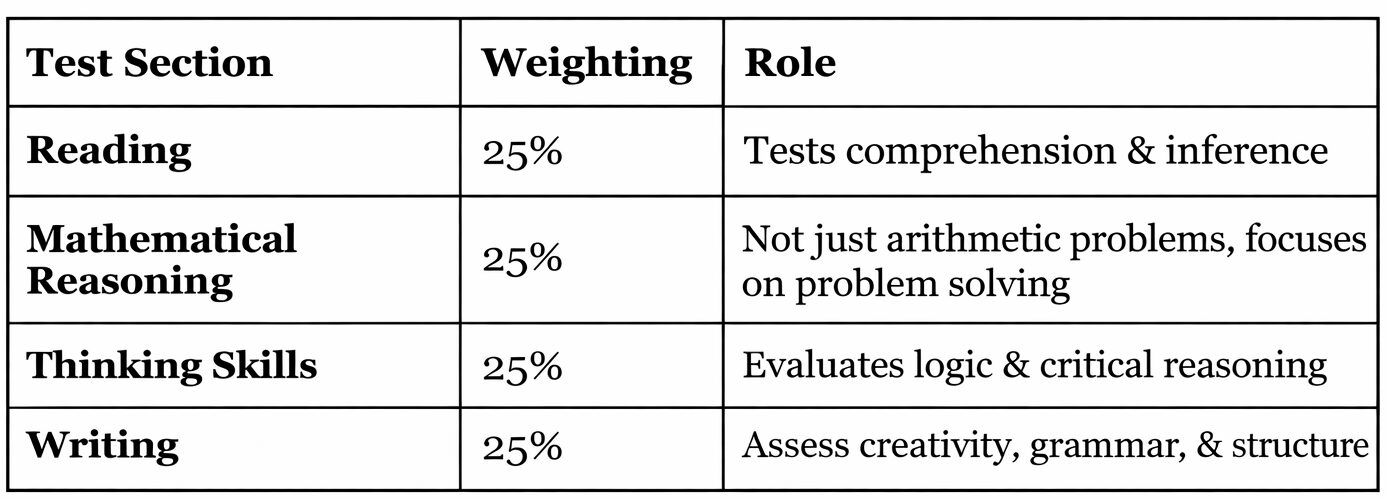
NSW Selective School Test- Knowing the “Good Score” for it
A “Good Score” in this case is relative to the school a student is aiming for. Because the test is norm-referenced (i.e. students are ranked against everyone else who sat the test that year), the cut-off score changes each year. It depends on the difficulty of the paper and the performance of the cohort.
Generally, here is how the scores align with school types:
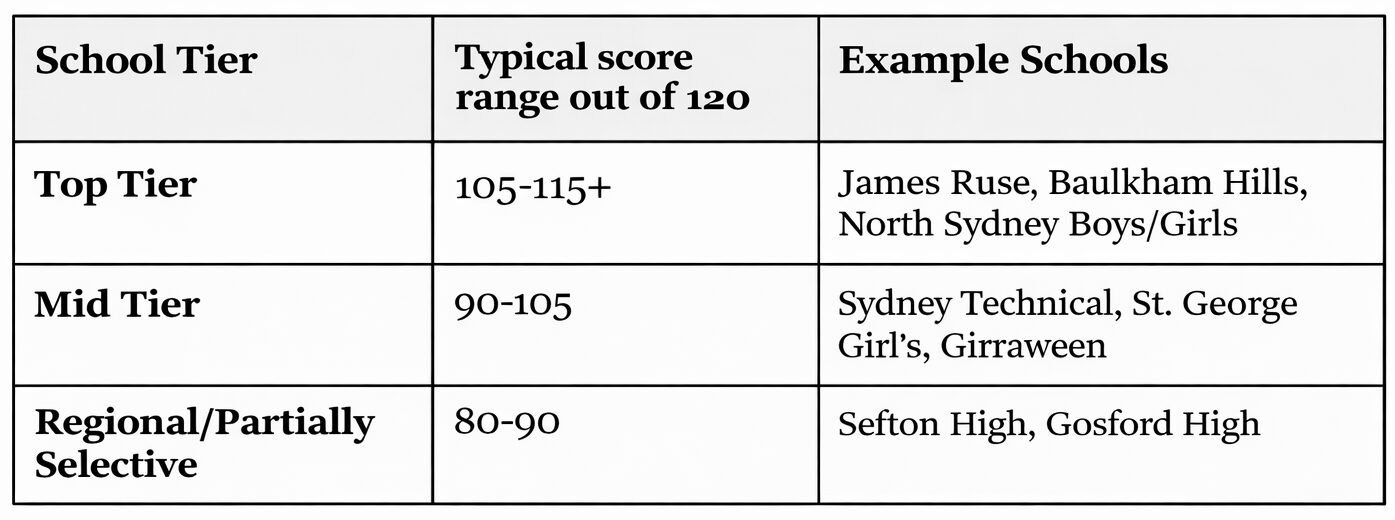
*Pro Tip: Aiming for a score in the top 10% (Performance Band 1) across all subjects is generally the safest way to ensure an offer from a top-tier school.
The Challenges of the new NSW Selective School Test format
The shift to digital testing has introduced several new hurdles like:
➤ The Clock is Ticking: Students roughly have 60 seconds per question in Thinking Skills and Mathematical Reasoning tests.
➤ The Digital Interface: Navigating drag-and-drop or dropdown questions can be distracting for students.
➤ Thinking Skills: This replaced General Ability and focuses heavily on logic and flaws in arguments. These skills are not typically emphasised in the standard school curriculum.
How Selectivetrial helps achieve NSW Selective School placement?
Success in this environment requires more than just intelligence; it requires strategic familiarity. This is where Selectivetrial becomes an essential partner, or rather the engine behind a student’s success.
➤ Realistic Simulation- The Selectivetrial platform is meticulously designed to mirror the actual computer-based test. By practicing in an updated digital environment, students overcome screen fatigue and master the interface long before the big day.
➤ Data-Driven Insights- One of the standout features of Selectivetrial is the Analytical Performance Report. Instead of just getting a raw score, parents and students see:
- Time Management Tracking: Which questions took too long?
- Weakness Mapping: Is the student struggling with geometry or inference?
- Peer Benchmarking: How does the score compare to the thousands of other students on the platform?
➤ Targeted Skill Building-
- Mathematical Reasoning: Moving beyond simple arithmetic to complex problem-solving.
- Thinking Skills: Specialised sets that teach students how to deconstruct arguments and identify logical fallacies.
- Expert Writing Feedback: Unlike many platforms that use automated bots, Selectivetrial offers experienced faculty who provide human feedback on structure and creativity.
A Winning Study Strategy with Selectivetrial
To achieve that “Good Score,” we recommend students this 3-step cycle using Selectivetrial:
- Diagnose: Take a full-length mock test under strict timed conditions to find your baseline.
- Analyse: Use the “Detailed Review” feature. Don’t just look at the right answer, also read the explanation for why the other options were wrong.
- Refine: Use the Question Bank to drill down into the specific categories where you lost marks.
A Good Score for the NSW Selective School Test isn’t an unreachable mystery—it’s the result of consistent, high-quality practice. By combining a student’s hard work with the advanced simulation and analytics of Selectivetrial, the path to a top-tier NSW Selective High School becomes much easier.