
Opportunity Class Test Practice Questions That Work

By Post Author | 29th Aug, 2026
A child can be strong in class and still lose marks in the Opportunity Class test by spending too long on one unfamiliar question. That is why opportunity class test practice questions should do more than fill an afternoon. Used well, they show whether your child can read precisely, reason efficiently and make sound decisions when the clock is running.
For NSW families seeking Opportunity Class placement, practice needs to reflect the thinking demanded by the assessment, not simply provide harder schoolwork. The aim is not to have your child memorise hundreds of question types. It is to build the habits that help capable students show what they know on test day.
What opportunity class test practice questions should assess
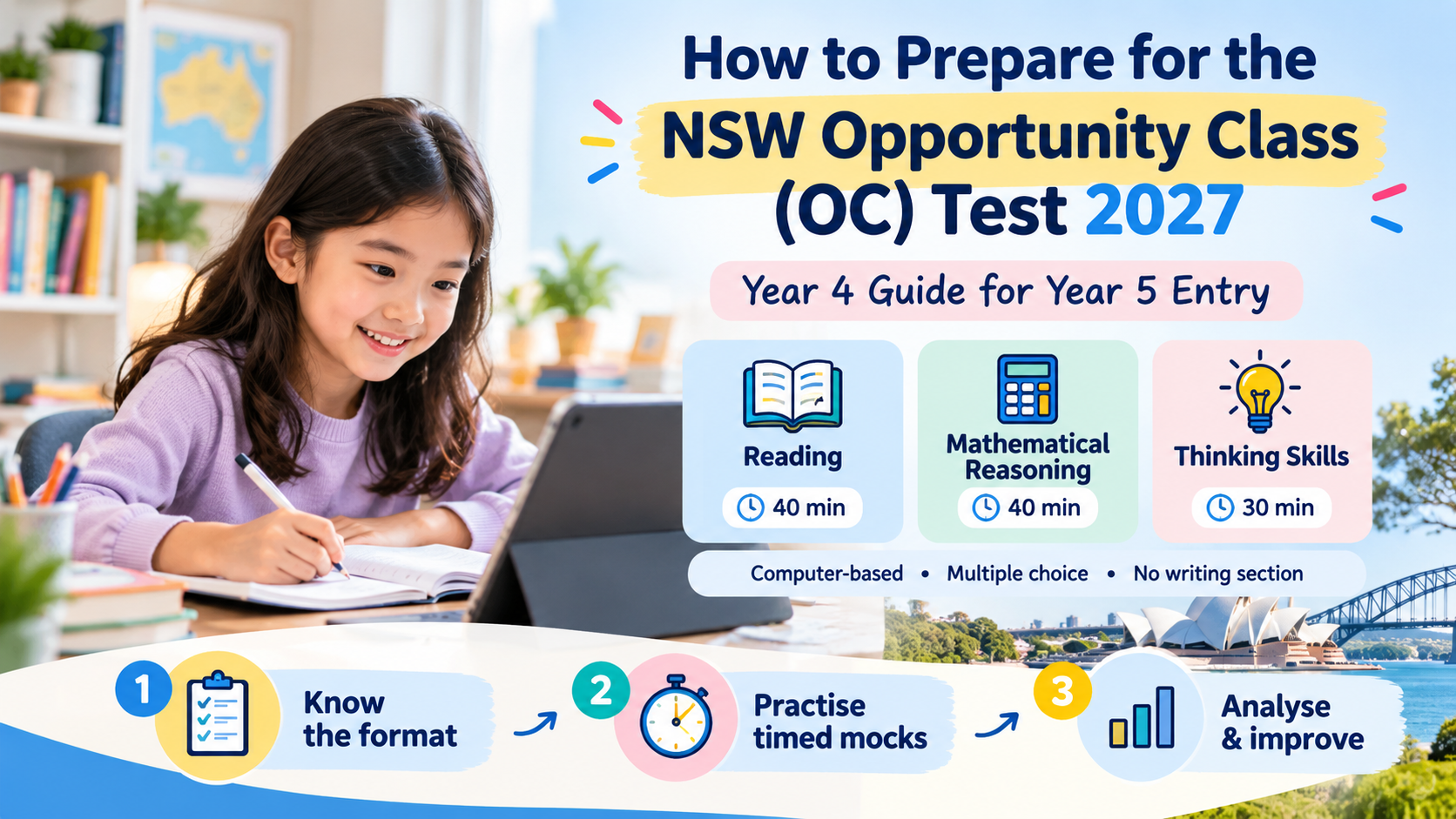
Quality practice questions should cover the core skills commonly assessed in the OC placement test: reading, mathematical reasoning and thinking skills. Each area calls for a different approach, so a single mixed worksheet rarely gives parents enough information about where a child needs support.
Reading questions should test more than locating a sentence in a passage. Children need practice identifying an author’s purpose, drawing an inference, comparing ideas and choosing the best-supported answer from plausible options. The strongest readers are not always the fastest at this initially. They learn to return to the text, distinguish evidence from assumption and avoid being distracted by an answer that uses familiar words but changes the meaning.
Mathematical reasoning questions should require students to select and apply knowledge, rather than repeat a recently learned classroom method. A child may understand fractions, measurement or number patterns in isolation but hesitate when those concepts appear in a multi-step problem. Practice should therefore include straightforward questions for fluency and more demanding questions that require careful interpretation.
Thinking skills questions assess patterns, relationships, rules and logical conclusions. These can feel unfamiliar because there is often less obvious classroom content to revise. The useful skill is disciplined reasoning: notice what changes, test a rule, eliminate answers that do not fit and check the final choice against every part of the question.
The exact test arrangements can change, so parents should always check current NSW official information. However, the preparation principle remains the same: match practice to the skills, question style and timed conditions your child will face.
Why more questions are not always better
A large volume of questions can be valuable, but only when it produces useful feedback. Completing 50 questions without reviewing mistakes may reinforce rushing, guessing or avoidable calculation errors. Completing 15 well-chosen questions, then understanding each error, can produce a better result.
Look for patterns rather than treating every wrong answer as the same problem. For example, a student who misses difficult mathematical questions may need a new strategy. A student who misses easy questions may be moving too quickly, misreading key words or failing to check calculations. Those are different issues and need different practice.
After each session, ask three simple questions: What did you find difficult? Why did the correct answer work? What will you do differently next time? This conversation is more helpful than asking only, “How many did you get right?” It teaches your child that a result is evidence, not a label.
Detailed worked solutions matter here. A solution should explain the reasoning pathway, not merely state the answer. When children can compare their method with an efficient method, they start to recognise when a quicker approach is available and when careful working is safer.
Build from untimed accuracy to test-ready speed
Parents often introduce strict timing too early. This can make a child feel that speed matters more than understanding, especially if they are still learning how to approach reasoning questions. A more effective sequence starts with accuracy, then adds pace in controlled stages.
Begin with short, untimed sets in one subject area. Encourage your child to explain their thinking aloud for a few questions. This makes gaps visible. If they cannot explain why an answer is correct, they may be relying on a guess or a rule they do not fully understand.
Once accuracy is reasonably consistent, introduce a gentle time target. Rather than saying, “Finish this as fast as possible”, set a realistic limit and track whether the child maintains accuracy. If their score drops sharply under time pressure, reduce the set length before increasing difficulty.
The final stage is timed mixed practice and full mock exams. These reveal whether your child can switch between different question types, recover after a hard question and manage their attention over a longer sitting. Real exam timing is useful because it exposes habits that subject practice can hide, such as repeatedly checking a difficult question or rushing the last section.
Teach a practical approach to difficult questions
The OC test rewards thoughtful decisions, not stubbornness. Children need permission to move on when a question is taking too long. This is particularly important for high-achieving students, who may be used to finishing every classroom task.
For reading, teach your child to identify what the question is asking before searching the passage. Is it asking for a fact, an inference or the main idea? For mathematical reasoning, encourage them to underline relevant information, estimate where possible and check whether the answer is sensible. For thinking skills, they should test each possible rule rather than choose the first pattern they notice.
A useful rule is to mark a question for review if progress has stalled. They can return with fresh attention after completing questions they can answer efficiently. This is not giving up. It is time management.
It also helps to discuss guessing strategically. If there is no penalty for an incorrect response under the current test rules, leaving a question unanswered may not be the best choice. Your child should first eliminate clearly unsuitable options, then make the most reasoned choice available. Confirm the current instructions before test day rather than relying on advice from older tests.
Use mock exams to find the real pressure points
A full mock exam should not be the first form of preparation, nor should it be used every weekend for months. Mocks are diagnostic tools. They work best after a child has had time to develop core skills through targeted practice.
Create conditions that resemble the actual experience: a quiet desk, one sitting, no hints, no breaks outside the allowed structure and a visible timer. Afterwards, review performance by skill area as well as overall score. A good total can conceal a weakness in one section, while a lower total may be caused by only a handful of recurring mistakes.
Pay attention to the final third of the test. If accuracy falls late in the session, the issue may be stamina rather than knowledge. If a child leaves questions incomplete, they may need pacing practice. If they change correct answers to incorrect ones, confidence and checking routines may be the focus.
Digital practice can make this review much clearer. Selectivetrial provides 35,000+ exam-style questions, timed mock exams, repeatable attempts, worked solutions and parent-facing progress analytics, allowing families to see whether improvement is occurring in the areas that matter.
Keep preparation challenging without making it overwhelming
Opportunity Class preparation can become stressful when every study session feels like a judgement on a child’s ability. Parents can protect motivation by keeping sessions focused and finite. Two or three purposeful sessions each week are usually more sustainable than long, frustrated study blocks.
Difficulty should increase gradually. If every question is easy, a child does not learn how to persist. If every question is far beyond their current level, they may stop trusting their own thinking. The right balance includes achievable questions, stretch questions and time to understand errors.
Avoid comparing your child’s scores with friends or siblings. The more useful comparison is with their own earlier performance. Are they making fewer careless errors? Are they solving a particular question type more efficiently? Are they calmer in a timed set? These are meaningful signs of readiness.
A strong practice routine gives your child something more valuable than a stack of completed worksheets: a clear understanding of how they think under pressure. Start with one targeted set, review it carefully, and let the next session be shaped by what the results reveal.